

About Martin Calvert
Martin Calvert is the Marketing Director at ICS-digital and ICS-translate, agencies working globally across some of the most competitive and tightly regulated industries online, including iGaming, finance, and technology. With experience on both the agency and client side, Martin brings a practical, commercial view of SEO that goes far beyond theory.
He is widely known for his work in digital PR, multilingual SEO, localisation, and content strategy and creation, helping iGaming operators and affiliates compete across multiple markets where trust, relevance, and compliance are critical. Martin focuses on building authority that holds up in real-world conditions, not just in search engine reports. In an industry where blackhat tactics often overshadow whitehat SEO strategy, Martin brings clarity to one of iGaming SEO’s most misunderstood disciplines: authority-building that actually lasts.
Interview — Why Link Volume Is Failing, How Authority Really Works, and What Google Trusts in iGaming
Few people have had as much visibility into link building as Martin Calvert. Working across agency environments and directly with operators and affiliates, Martin has seen how link strategies break down when they prioritise volume over credibility, and how the brands that survive long term approach authority very differently.
In this interview, Martin explains why iGaming clients keep repeating the same link-building mistakes, how Google evaluates links in one of the most aggressive SERPs online, and what operators and affiliates should focus on instead if they want rankings that last.
Q: Martin, you’ve worked closely with both iGaming operators and agencies for years. What’s the most common misunderstanding clients still have about links?
A: I think one of the biggest issues with SEO is that out-of-date information has a huge lifespan and (like a meme) gets repeated and repeated resulting in strategies that aren’t reaching their full potential.
Given the number of SEO experts in iGaming, I think that is less of a problem in the industry but it is still in the background. More than this, search engines and LLMs are always going to be deliberately mysterious about what ‘works’ as they understandably want the best sites to rank – not the sites with the best SEO team.
In all of this, I think there can be many cases where people bother over- and under-appreciate that importance of links.
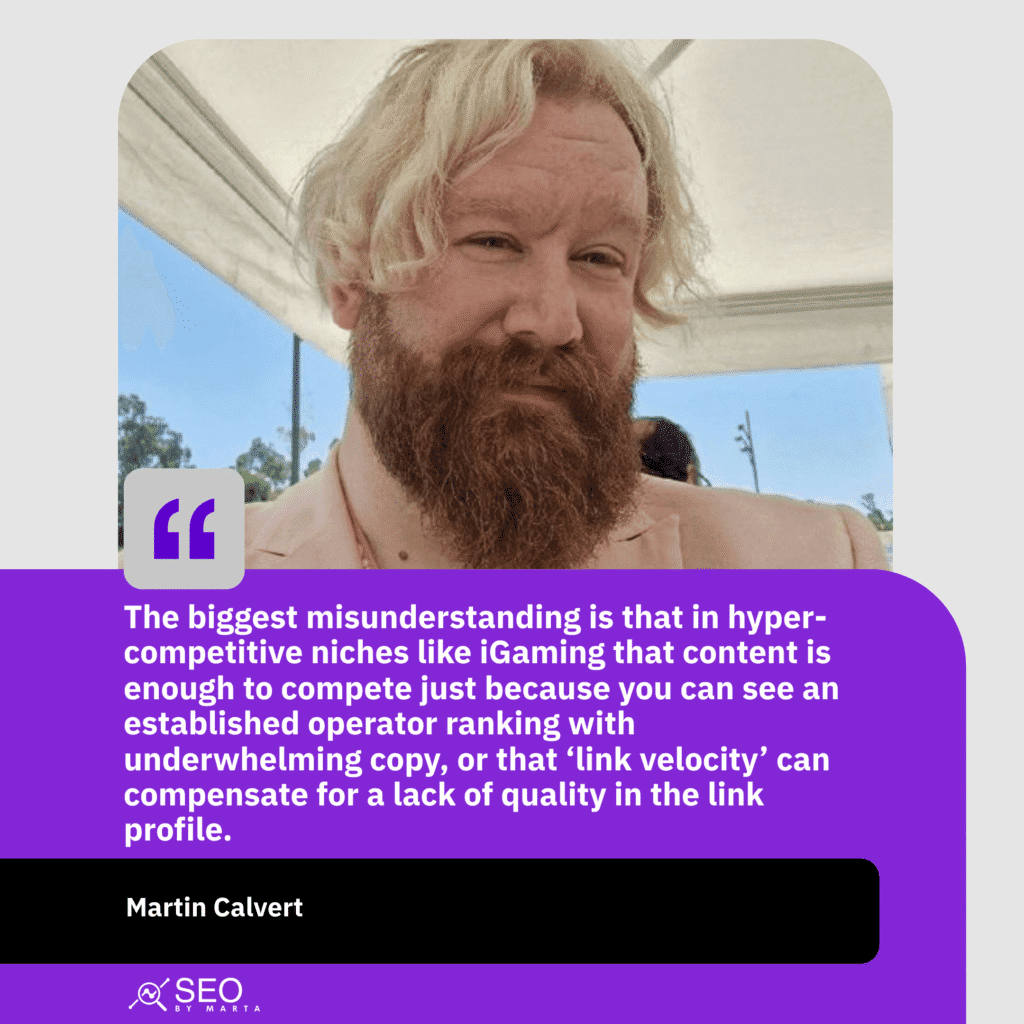
Overall I’d say the biggest misunderstanding is that in hyper-competitive niches like iGaming that content is enough to compete just because you can see an established operator ranking with underwhelming copy, or that ‘link velocity’ can compensate for a lack of quality in the link profile.
Q: Why do you think iGaming clients are particularly drawn to link volume and shortcuts compared to other industries?
A: I think part of it is the dynamic nature of the industry, and the fact that a lot of the earliest adopters of SEO were gaming brands with an experimental, growth-focused mindset. They didn’t fully believe everything Google was saying and would to an extent bet on themselves to figure things out.
I think once you’ve had success in that it can be hard to adapt as things move on – and even understand when that happens. Afterall, if we were to believe the search engines a lot of methods that work really well now ‘should’ have been out of date ten years ago.
That said, it is important to realise when the easy paths are becoming less easy and understand the full mix when it comes to how site authority is meaningfully and cost-effectively grown with the addition of things like influencer relations, PR, disciplined tech SEO/internal linking plans and so on…as well as the succinctness of content.
Q: Many clients still rely heavily on metrics like DR or DA. Why do these numbers fail to reflect real authority in gambling SERPs?
A: As an indicative measure, at ICS-digital we quite like DR and DA and these are metrics clients can filter on in our link marketplace.
While it is definitely possible to see weak sites with artificially inflated DA, it feels less likely to we see phenomenal sites with low DA so at the every least, it allows us to filter and take a closer look.
Any metric by itself will always be of limited use, but once analysed alongside other metrics you can begin to build a better picture of how good a site for backlinks really is.
The other key measure worth looking at alongside DA/DR is (of course) traffic – it’s easy to see a site that’s been “punished” by Google if estimated traffic is at zero – even if a site like that has a high DR, it’ll probably be worth avoiding. That’s just a general example.
Beyond this, relevance and customer experience to specific queries/keyword clusters are things that SEO tools aren’t always the best at measuring – especially in a very specific niche like gambling.
With this in mind, it is worth taking a longer term and more-in-depth view of how well each site maps to *your* content and how the relevance of its traffic can have an outsize impact on *your* performance.
Mimicking competitors may be a starting point but the more specific the strategy, the more meaningful the results – especially if you can secure links from sites on the rise.
Q: From your experience, what types of links are iGaming brands consistently overpaying for and why?
A: I think this differs by company size – anecdotally, I feel like for newer brands it can be no bad thing to get a ‘baseline’ of links from sites that are already used by competitors as it feels like this helps communicate to search engines and LLMs which ‘neighbourhood’ the site is in. We’ve seen brands do the opposite with some great links but who don’t benefit from commercial, transactional rankings.
One brand I can think of ended up being seen by search engines as more as a news site than an affiliate site which is not the commercial model.
With this is mind, I think it is possible to overpay for ‘prestige’ links that don’t bring customers closer, especially if brands have some kind of parasite SEO strategy where links don’t end up staying live for long, or are buried deep in a news site.
Certainly there are always those who believe in quantity over quality and while it can be satisfying to see links flood in, any strategy that doesn’t reap rewards is ultimately an exercise in overpaying – even if the per link cost is low.
Q: How should link strategies differ between affiliates and operators, especially given the risk and regulatory pressure operators face?
A: I think this is a very difficult question and really requires those on all sides to a.) have an understanding of the regulatory landscape and b.) communicate their own appetite for risk internally and with their affiliate/operator partners.
If there’s a mismatch, problems can arise in the relationship if not with regulators.
Increasingly affiliates are having similar pressures to operators in regulated markets so the sooner they evolve their operations to fit within regulatory guidelines the better. The advantage of this should be the ability to broker better deals based on operators appreciating that their own risk is minimised.
In terms of link building strategies, all this means understanding that link building is seen as a type of advertising and so brands must understand which audiences publishers target and how article content, messaging and branding must be shaped around that. It takes granular insight which may differ from the ‘fast and loose’ approach of some of the early adopters of iGaming SEO.
There’s an element here where agencies can help guide and inform but it is a two-way street.
Q: What role does content play in earning links that actually move rankings in iGaming, rather than just padding reports?
A: I think content plays a huge role – in fact I’m old enough to remember when what we now call ‘digital PR’ was described as content marketing – using content to differentiate from competitors and earn links.
All of this is with the understanding that ‘good’ content is not inherently linkable. Linkable by who? Who will be doing us this massive favour to boost our SEO?
The type of content that goes beyond padding has to provide justification for the link and help journalists tell a story, make fans laugh/rant, bring industry partners together or something else that prompts an emotional or practical response where linking makes sense.
Q: How do you explain the difference between “having links” and “having authority” to stakeholders who only care about rankings?
A: Caring about *relevant* rankings is an understandable focus for stakeholders in digital businesses but it is important to take a dispassionate view of strategy.
Some stakeholders certainly like to see volume but could experience diminishing returns if there aren’t corresponding efforts to become an authority in the space – or maintain existing authority if relying on past success.
That means taking a really in-depth look at how technical SEO, multichannel (and increasingly multilingual) content comes together to create (or maintain) the attributes of a trusted, authentic brand – something that amid all the various algorithm updates we know Google is drawn to and that risk-to-user-conscious LLMs prefer to mention.
Q: Are there link-building tactics you believe iGaming brands should stop using altogether in 2026 and beyond?
A: Anything that involves paying for a time-limited ‘tenancy’ on a site seems like not a good use of resources to me 🙂
Q: Brand mentions and unlinked citations are often ignored. How valuable are they compared to traditional backlinks in today’s search landscape?
A: This is difficult to quantify as, with other aspects of SEO, the benefits to some brands may be greater or smaller when compared to another brand.
Certainly when building up the attributes of a brand and a footprint that builds visibility more generally to bring customers closer/win traffic it feels like an essential element.
That said, for site discovery, passing authority and building rankings for clusters of keywords in competitive sectors, I think do-follow links will continue to have a huge role.
Conclusion
Martin Calvert exposes why iGaming SEO’s link obsession fails: volume doesn’t beat relevance. In 2026’s brutal SERPs, Google rewards trusted authority- think digital PR, compliant content clusters, and technical signals like clear licensing over tenancy links or DA chasing.
Operators and affiliates must ditch blackhat shortcuts for customer-focused strategies that survive updates and regulations. Winners build links as conversion pathways, not report padding. Legacy brands endure through genuine relevance, not hacks. The message? Evolve or evaporate.