

Expert Interview with Nitin Manchanda
About Nitin Manchanda
Nitin Manchanda is a globally recognized SEO nerd, product thinker, and the founder of Botpresso, a consultancy focused on building scalable SEO systems for fast-growing companies. With experience as an in-house SEO leader at companies like trivago and Omio, Nitin combines deep technical SEO expertise with a product-driven mindset.
At Botpresso, he focuses on bridging the gap between SEO and engineering, helping teams move beyond manual workflows and build automation-first SEO processes that scale. His work centers on eliminating operational inefficiencies and designing systems that enable sustainable organic growth.
Nitin is a regular speaker at industry conferences and mentors SEOs navigating the rapidly evolving intersection of automation, AI, and performance metrics.
Interview – What Actually Works in SEO Automation
SEO automation has become one of the most talked-about and most misunderstood topics in the industry. From internal linking and audits to large-scale content generation, the real question is no longer whether SEO can be automated, but what should be automated and how.
In this interview, Nitin Manchanda shares practical lessons from years of building SEO systems at scale. He explains what automation actually works, where most teams get it wrong, and how to design smart, scalable SEO processes that deliver meaningful results.
Q: Nitin, you’ve led SEO efforts at major brands and now work with clients through Botpresso. What was the moment when you realised SEO automation could be a serious growth lever?
A: The real turning point for me happened when working at scale at companies like Flipkart, trivago, and Omio. When you manage millions of pages, you quickly realise that manual SEO simply doesn’t scale. I saw that the biggest gains didn’t come from one-off optimizations, but from building systems like automated internal linking, scalable templates, and monitoring workflows.
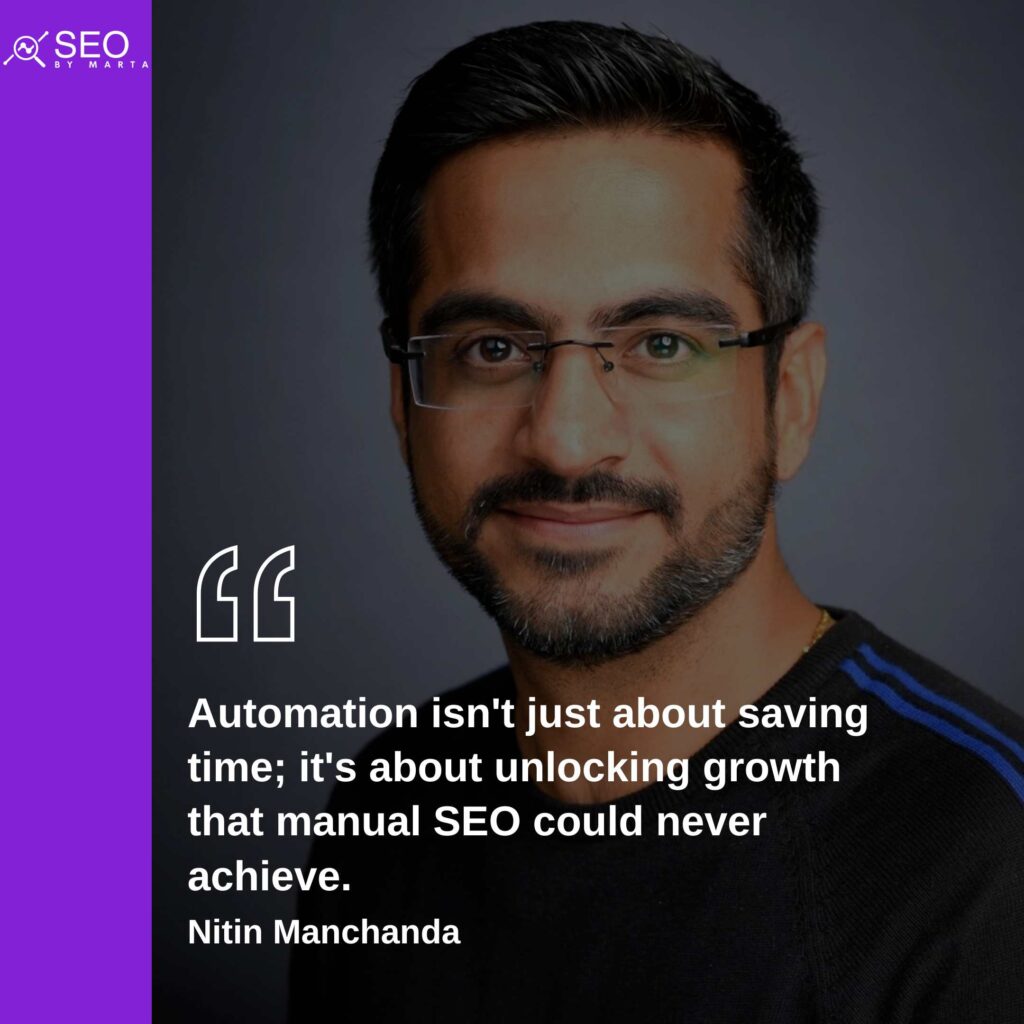
Once those systems were in place, improvements multiplied across thousands or millions of pages. That’s when it became clear to me that automation isn’t just about saving time, it’s about unlocking growth that manual SEO could never achieve.
Q: Many companies jump into automation without a clear strategy. What do you think are the biggest misconceptions about SEO automation in 2026?
A: One of the biggest misconceptions is that automation means “doing everything automatically.”
In reality, automation should amplify human expertise, not replace it. Another misconception is that automation equals AI-generated content. Most impactful automation actually happens in areas like technical monitoring, internal linking, data analysis, and workflow efficiency.
Finally, many teams underestimate the importance of data quality and engineering collaboration; automation without clean inputs or proper systems often creates more problems than it solves.
Q: What are the most valuable SEO tasks or workflows you believe should be automated today?
A: The biggest wins usually come from repeatable, data-heavy processes. For example: automated technical SEO audits, reporting, internal linking suggestions, keyword clustering, performance monitoring, and content opportunity discovery.
Another powerful area is anomaly detection – systems that automatically flag drops in rankings, indexation issues, or crawl problems. These workflows free up SEO teams to focus on strategy instead of spending time on manual diagnostics.
Feels like I just dumped the automation roadmap we have for the first half of 2026 at Botpresso.
Q: What’s the must-have SEO automation setup in 2026? Can you walk us through a basic, step-by-step stack or workflow that every team should implement? (you can add screenshots here please if needed)
A: A solid automation setup doesn’t have to be complex. I usually recommend a simple layered approach:
1) Data collection: Gather data from sources like Google Search Console, Google Analytics, crawl tools, and log files.
2) Data processing: Use scripts or automation platforms to clean, combine, and analyze the data.
3) Insight generation: Build dashboards or alerts to detect issues like traffic drops, indexing problems, or keyword opportunities.
4) Execution automation: Automate actions where possible – internal linking suggestions, metadata generation, schema deployment, or redirects.
5) Monitoring: Set up continuous monitoring to detect anomalies or performance changes. The key is building a feedback loop where insights lead to automated actions, and results are measured continuously.
Q: What are the most valuable SEO automation tools you can recommend?
A: The most valuable tools depend on a team’s technical maturity, but in 2026, the real power comes from combining data providers, crawlers, and workflow automation tools into a connected system. For large-scale SEO data, APIs are essential. Providers like DataForSEO offer scalable access to keyword data, SERP results, and ranking information, which makes it possible to build custom workflows without relying entirely on traditional SEO interfaces. Similarly, APIs from platforms like Semrush and Ahrefs allow teams to pull competitive intelligence, backlink data, and keyword insights directly into internal systems or dashboards.
For crawling and technical analysis, Screaming Frog SEO Spider remains one of the most powerful tools available. It’s especially useful because it can be automated, scheduled, and integrated with other data sources to continuously monitor technical issues across large sites.
Another emerging layer in the stack is data extraction and crawling infrastructure. Tools like Firecrawl help automate large-scale web scraping and structured content extraction, which can be useful for competitive analysis, content audits, or training internal SEO datasets.
Where things really become powerful is in the automation layer. Platforms like n8n allow teams to connect different data sources – APIs, crawlers, analytics tools, and automate workflows such as keyword clustering, anomaly alerts, internal linking suggestions, or reporting pipelines.
Finally, newer AI-powered development tools like Lovable are making it easier for SEOs to build lightweight internal tools and dashboards without needing full engineering resources. This lowers the barrier for experimentation and allows teams to prototype automation ideas quickly.
When you combine these layers – data APIs, crawlers, workflow automation, and lightweight development platforms – you can build a flexible SEO automation toolkit that scales far beyond traditional manual workflows.
Q: On the flip side, which parts of SEO should remain human, and why?
A: Strategy, prioritization, and creativity should always remain human-led. Automation can process data and execute tasks, but it can’t fully understand brand voice, market context, or user intent. Humans are still essential for defining SEO strategy, interpreting ambiguous data, designing experiments, and aligning SEO with broader business goals. Automation should handle the “how,” while humans focus on the “why.”
Q: Tools like ChatGPT and AI content generators have created a flood of low-quality content. How can automation be used responsibly in content production?
The key is using automation to build systems, not spam pages. A big focus of my work and something I’ve spoken about at international conferences is Programmatic SEO (pSEO) combined with AI.
For global brands, scaling content across multiple languages and markets is extremely difficult if done manually. Programmatic SEO solves this by combining structured datasets, templates, and automation logic to create thousands of useful pages targeting long-tail demand. AI can support this process by generating briefs, clustering keywords, or assisting with localization, but human expertise still plays a critical role in ensuring quality and accuracy.
When done correctly, automation doesn’t replace content teams; it removes repetitive work so they can focus on insight, relevance, and user value. The goal is scalable content systems, not mass-produced content.
A couple of references you might want to share here:
https://www.slideshare.net/slideshow/role-of-ai-and-pseo-in-scaling-content-iss-barcelona-2024/275283811
https://www.slideshare.net/slideshow/pseo-to-scale-seo-growth-by-nitin-manchanda-at-shenzhen-seo-conference-2025/283305209
Q: Let’s talk data. What metrics or signals do you monitor to ensure automation is actually improving SEO performance?
A: I usually monitor a mix of performance and technical metrics. On the performance side, key signals include organic traffic, keyword visibility, click-through rate, and conversion impact.
On the technical side, I track crawl efficiency, index coverage, page discovery, and internal linking depth. It’s also important to monitor anomalies – sudden changes in rankings, crawl patterns, or indexation can signal that an automated system is behaving unexpectedly.
But honestly speaking, these KPIs vary a lot from project to project. Therefore, I aim to understand the immediate KPIs my project would affect, while keeping an eye on the ultimate goal to set those north star metrics too.
Q: You work closely with developers and product teams. What does a good SEO and engineering collaboration look like when building automated systems?
A: Good collaboration happens when SEO is integrated into product development rather than treated as an afterthought. That means defining SEO requirements early, documenting them clearly, and aligning them with product goals.
The best results come when SEO teams provide structured requirements, like templates, logic for internal linking, or schema rules, and engineering teams implement them as scalable systems rather than manual fixes. It becomes less about individual SEO tasks and more about building SEO into the product architecture.
Q: Schema markup, internal linking, redirects, and log file analysis: where do you see the biggest technical SEO automation wins happening?
A: Internal linking is probably one of the biggest opportunities because it’s highly scalable and directly impacts crawlability and rankings (maybe I’m biased). Schema markup is another area where automation works extremely well, especially when structured data can be generated dynamically from existing page information. Redirect management is also a strong candidate for automation, particularly for large sites with frequent URL changes. Finally, log file analysis can be automated to detect crawl inefficiencies and ensure search engines are spending their crawl budget on the right pages.
Q: What are some common pitfalls or risks that SEO teams should watch for when scaling automation?
A: One major risk is scaling mistakes. If an automated rule is wrong, it can affect thousands of pages instantly.
Another pitfall is over-automation – building overly complex systems that become difficult to maintain. Teams should also watch for poor data inputs, because automation is only as reliable as the data feeding it. The safest approach is to test automation on smaller segments first, monitor results carefully, and gradually scale once the system is validated.
Q: How can smaller teams or solo SEOs use automation without overcomplicating their workflow?
Smaller teams should focus on high-impact, low-complexity automation. For example, automated reporting dashboards, keyword clustering, and alert systems for ranking or traffic drops can save a lot of time.
Using AI tools for research, outlining, and data analysis is also very effective. The key is not to build complex infrastructure but to remove repetitive work. Even simple automation can free up significant time for strategy and experimentation. That’s how we started the whole initiative at Botpresso.
Conclusion
Nitin has been doing SEO long enough to know what actually moves the needle and what just looks good in a slide deck.
The thing that stuck with me most is how simple his core argument is. Automate the boring, repetitive stuff so you can actually think. Not groundbreaking advice on paper, but most teams still aren’t doing it.
If you took anything from this conversation, let it be that. Start small, start somewhere, and stop doing what a script could handle in seconds by hand.