
About Kasra Dash
Kasra Dash is a Scottish entrepreneur and recognised SEO expert. Kasra Dash founded The Masterminders, one of the best SEO conferences in the world, and mySEO App, a private invite-only platform connecting verified SEOs, agencies, and suppliers. Kasra Dash is known for building systems, frameworks, and communities that help marketers grow together. His recent work focuses on AI Overviews, Search Generative Experience (SGE), and how automation is reshaping the fundamentals of visibility and trust.
Interview Introduction- How AI-generated Results, Entity Systems, and Automation Will Redefine Ranking Strategies — and what SEOs Must Do to Stay Relevant
Search is evolving faster than anyone expected. Google’s AI Overviews, the rise of SGE (Search Generative Experience), and the explosion of automation tools are not just changing the way users discover content — they’re redefining the entire structure of SEO. For Kasra Dash, this evolution isn’t something to fear — it’s a challenge to decode. In this exclusive SEO by Marta interview, Kasra and Marta explore how AI, entities, and automation are changing the fabric of search, what SEOs must unlearn to stay competitive, and how to build strategies for an AI-first world. This is more than a conversation about rankings — it’s a blueprint for the next chapter of organic visibility.
Q: Kasra, let’s start with the big picture — what does “The Future of Search” mean to you in 2026?
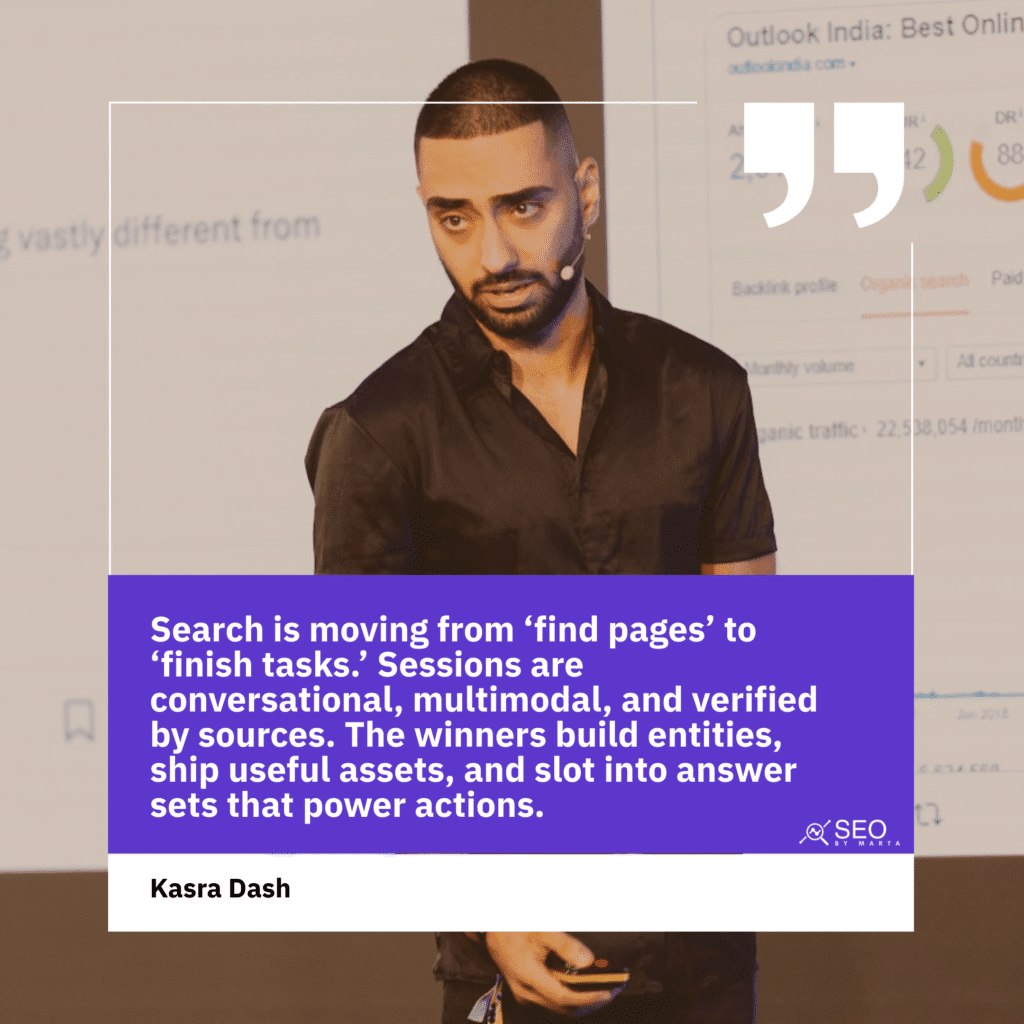
A: Search is moving from “find pages” to “finish tasks.” Sessions are conversational, multimodal, and verified by sources. The winners build entities, ship useful assets, and slot into answer sets that power actions.
Q: How have AI-generated results like Google’s AI Overviews changed the concept of ranking visibility?
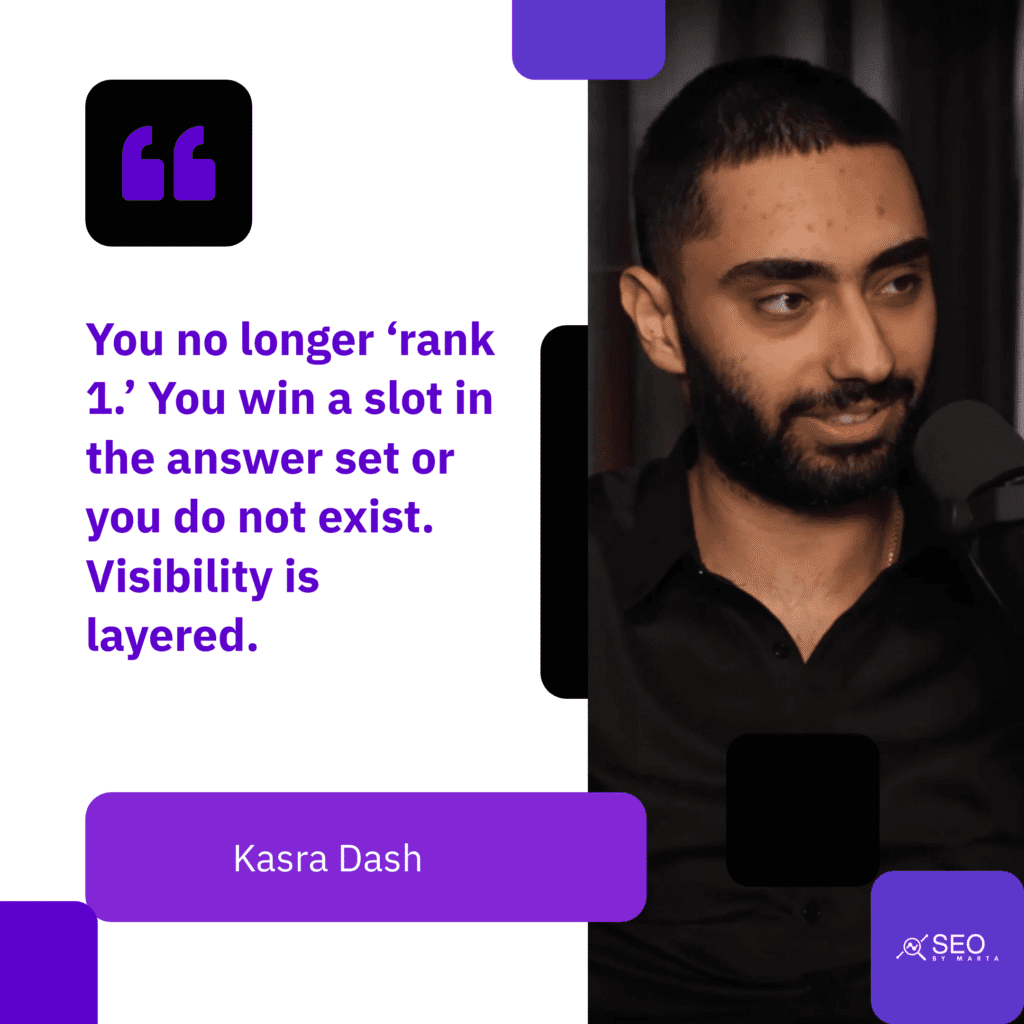
A: You no longer “rank 1.” You win a slot in the answer set, or you do not exist. Visibility is layered. There is the generated answer, the citations list, and the follow-up suggestions. Slot share beats blue links.
 Q: You’ve done live experiments on AI Overviews. What patterns have you noticed in which sites or content get selected?
A: Pages with clean entity signals, precise answers, and real citations get picked. Diversity of sources wins. Recency matters for queries with time sensitivity. Government, academic, and primary data beat fluff. Helpful formatting helps the model extract.
Q: Do entities now matter more than traditional keyword optimization? How can SEOs adapt to entity-based ranking?
A: Entities are the canvas. Keywords map to intents on that canvas. SEOs should build entity graphs across site, author, organisation, products, and topics, then use keywords to route demand to those nodes.
Q: What role does automation play in modern SEO — and how do you make sure it supports creativity rather than replacing it?
A: Automate the pipeline. Never automate the perspective. I use automation for clustering, briefs, internal links, QA, and change monitoring. Humans provide stories, proofs, and edge cases.
Q: How should SEOs adjust their content strategies to remain visible in SGE and other AI-enhanced search environments?
A: Lead with the answer, then earn the citation. Create compact claim blocks with sources, followed by depth. Build comparison tables, process diagrams, and calculators. Keep data fresh. Make About and Author pages bulletproof.
Q: Does authority still come from backlinks, or is Google now prioritizing context and semantic relationships?
A: Links still matter as evidence of consensus. Context now carries heavier weight through schema, co-citation, and topical coverage. Build authority with cited assets, not random guest posts.
Q: You’ve often said testing is everything. What kind of tests are you running today to understand AI-driven ranking behavior?
A: I test inclusion rates, slot persistence, and swap experiments. I toggle schema types, author bios, and intro summaries. I test freshness deltas, data table presence, and source diversity. I measure how many prompts it takes to surface my brand across related intents.
Q: What mistakes do you see SEOs making when trying to optimize for AI Overviews or generative results?
A: People optimise for screenshots, not systems. They ship AI-slop, skip citations, and ignore entities. They bury answers under fluff. They neglect About pages, author identity, and crawl speed.
Q: Beyond Google — are you seeing similar trends in SearchGPT, Perplexity, or other AI-based search engines?
A: All of them chase trustworthy answers with transparent sources. Perplexity loves primary docs and code. SearchGPT values stepwise reasoning with references. Brave and Bing show similar behaviours. Make your site bot-friendly, offer clean APIs or datasets, and ensure licensing allows reuse.
Q: How can smaller brands compete against larger publishers in an AI-dominated search ecosystem?
A: Go narrow. Own a slice of the graph. Build the best resource for one problem and ship primary data. Partner with credible organisations. Be the fastest to update. Contribute experts as named authors across third-party sites.
Q: Finally, if you could leave one message for SEOs preparing for the next five years, what would it be?
A: Go to meetups. Attend conferences. Network with people who are ahead of you. That’s how you truly get ahead of the algorithm — by learning directly from those testing, failing, and winning in real time. Algorithms evolve, but conversations give you the shortcuts.
Conclusion
Kasra sees search not as a battlefield of blue links, but as an ecosystem of data, identity, and trust. In his view, the future of visibility won’t be decided by who writes the most, but by who structures information well enough for machines to understand it and rich enough for humans to believe it.
What sets Kasra apart is his balance of engineering precision and human instinct. He talks about algorithms, but he also talks about people, community, and the importance of learning from those who are actually testing and adapting in real time.
As AI reshapes the rules of search, Kasra’s message feels like both a warning and a roadmap.
The next wave of SEO will belong to those who build entities, trust, experiences, and ecosystems and not just pages.