
2025 was a challenging year for SEOs, and the rise of AI search, along with the ongoing changes to the search landscape, will continue into the new year. 2026 isn’t slowing down, and AI search will continue to rewrite user behaviour. The future of SEO prioritizes the user experience, and “adaptation” should be the new main keyword and motto for digital businesses.
In this article, you will find the top 9 SEO predictions for 2026 from industry experts.
1. Declining of Clicks and Traffic from Search Engines
Barry Schwartz, CEO of RustyBrick, founder of the Search Engine Roundtable blog, and a journalist for Search Engine Land
What Barry said:
I suspect we will see Google and Bing try to incentive publishers to continue to create content in a world where clicks and traffic from search engines continue to decline. This will likely be in the form of promised changes to the search interface, that ultimately continue to fail to improve click-through rates from search to publishers. I do not expect Google or Bing to pay publishers, despite how much pressure we see from the publishing community and Cloudflare.
2. The Era of Patternless Patterns in the Post-Generative AI Era is Coming
Koray Tugberk GUBUR Founder of Holistic SEO & Digital
What Koray said:
Google prioritizes originality, uniqueness, real human effort, and functional responsiveness over “relevance for the sake of relevance. This means web entities must develop unique, non-repetitive patterns while still staying inside certain design principles and relevance boundaries. Concepts like “Content Effort” from the Quality Rater Guidelines, or contentEffort from Google’s Content Warehouse API Leak, and Google’s preference for functional websites (e-commerce, SaaS, utilities, and even Reddit-style forums) all show that Google rewards sites that do something useful, not just sites that match keywords.

Every query-pattern deserves its own document-template that helps the search engine understand the declarations, structure, and purpose. But if the pattern becomes too rigid or repetitive, it looks fully automated and loses value. This is why maintaining a “patternless pattern” across content briefs, layout decisions, internal links, anchor texts, and co-occurrence signals is essential.
The shift forces every brand, SEO, or agency to abandon “text-for-text” production and move toward functional, patternless, high-effort information systems. Google is no longer rewarding relevance alone, it rewards responsiveness, originality, and unique design-function interactions.
This impacts brands because their websites will be evaluated by how much human effort they demonstrate, whether their documents show unique structural patterns across query classes, and whether their entity home provides stable, consistent semantic boundaries.
Agencies that rely on templates or mass-produced briefs will lose value, since Google’s LLM-driven cost-of-retrieval systems punish repetitiveness.
SEOs must understand that every query, entity, and intent cluster forms its own search-behavior signal network, and the ones who can model, map, and satisfy these thresholds with non-automated or uniquely automated structural variance will be the ones who win.
Below, you can see a very simple SEO Case Study.
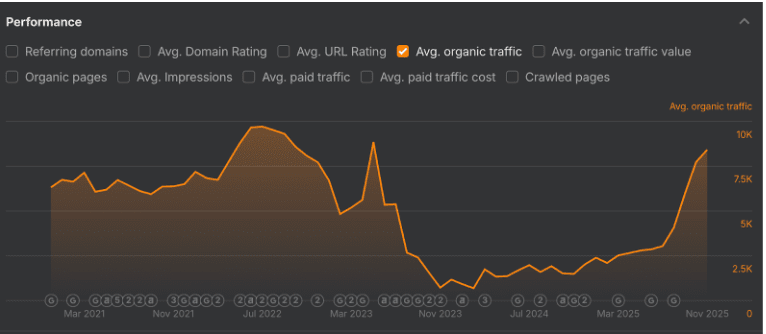 The website segment experienced significant ranking losses during the 2022–2023 Quality and HCU/HCS updates. It returned to its previous performance levels only after we refreshed the content by balancing structured vs unstructured and factual vs opinionated information, supported by responsive and functional web components.
We expanded every type of contextual layer, added missing predicates and triples, and introduced Q&A and Poll components to strengthen signals of human effort and user interaction.
Even though the structure follows a pattern, it does not repeat itself excessively, this is exactly what we mean by patternless patterns.
Example URL: https://www.eharmony.com/senior-dating/
3. Instability and Growth of Black Hat Tactics
Ivana Flynn, SEO consultant for iGaming and Adult
What Ivana said:
Similar to 2025, I believe 2026 will see a growth of abuse of black-hat tricks and tactics.
I believe Parasite will play a very important role for several reasons:
The EU is looking to regulate Parasite, this would make it a ‘go to practice’ even for everyone who was, till now, frowning upon this practice. Suddenly, they would consider them as a part of their strategy: https://www.wsj.com/tech/eu-opens-new-digital-markets-act-investigation-into-alphabets-google-f40ef557
If the regulation happens, the Parasite game will change as the players with massive budgets will enter the Parasite arena.
As well, due to the increase, it will probably be less effective.
I would question here, which type of Parasite practices will be regulated, from the sound of if, I am guessing it would mainly concern and impact partnership approach.
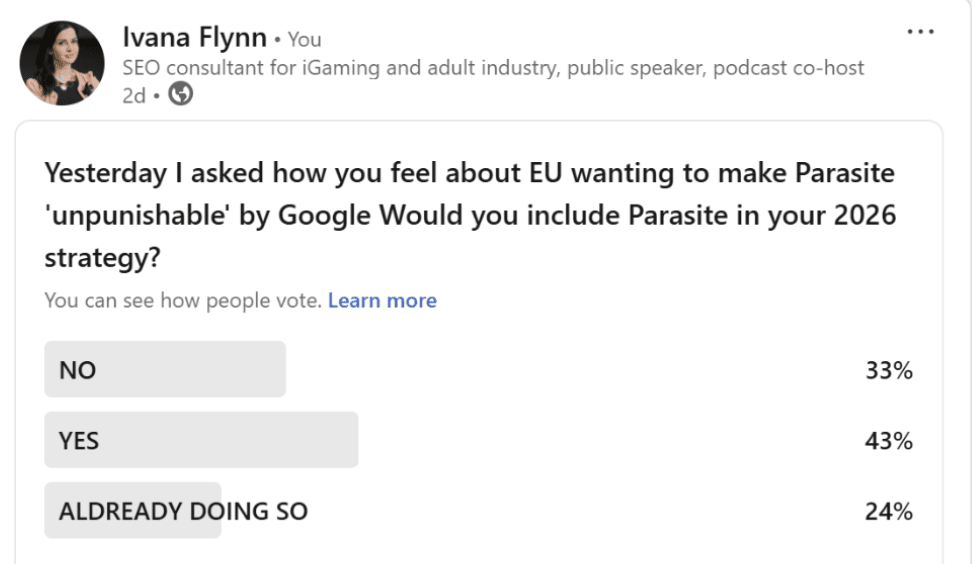
More and more people are considering Parasite as a good way to gain SEO traffic as per my poll:
Parasite simply works! And you should at least test it to understand it!
However, there are more grey/black tactics that work like magic, from dropped domains to traffic manipulation. Again, I preach a cautious approach. Be clever about the tactics you include in your strategy and be even more careful who you trust as a provider.
4. Keyword Research Will Be Crucial for Wider Marketing and Business Strategy
Natalia Witczyk, International SEO Consultant and CEO atMosquita Digital
What Natalia said:
The cognitive overload will affect users more and more in 2026. Endless ads, SERP overload, new AI tools will result in the digital fatigue kicking in.
For that reason, the brands will need to unify their messaging and make their brand positioning more lean, throughout all the platforms. Each website is going to need a solid headline that describes the core business problem they solve. One main business phrase that’s tailored and perfected, as well as secondary business keywords. That’s why Keyword Research will grow in importance – it will be the core process for establishing the perfect business slogan, which will combine linguistic precision with the search trends.
The keyword strategy will become a crucial step and will serve more channels than just SEO: it will inform the strategy for Social, Paid, E-mail, AI SEO and even offline marketing. Nailing that main keyword messaging will be crucial for marketing success everywhere. And the SEO Experts who understand that will start to play an important and transversal role in their organisations.
5. AI Is Your New Front Door. Optimise or Get Forgotten
Tom Winter – Founder at SEOwind
What Tom said:
LLMs will stop being “somewhere out there” and become an extension of your site. Users will learn about your product, your services, even your pricing inside AI assistants before they ever hit your homepage. And because these models are finally getting better at citing sources, the brands that feed them the right context will win the clicks and the customers.
The shift is already happening. You are no longer optimizing only for Google’s crawler. You are optimizing for every model that can talk about your business. If an LLM cannot explain what you do, you have already lost.
So what should teams do?
Treat your content like training data. Tighten your topical authority, clarify your value props, and structure your knowledge so models cannot misinterpret you. In 2026, visibility will not be about rankings alone. It will be about being the answer AI trusts enough to repeat.
6. 2026 is a Year of Link Building Renaissance
Michał Suski Head of Innovation & Co-Founder @Surfer
What Michał said:
Building links is getting a new wave of interest due to AI SEO. Simple insertions, exact match anchors – these do not do the trick for AI search. There must be a brand context and proper opinion. Sometimes even more important than the backlink itself. Companies who understand it first and start building links / citations on frequently cited websites will win with competition. Top most cited domains in AI search list? It does not make sense. Top most cited specific pages in particular niche, some most important prompts – this is ready to use outreach list. We understand this and decided to build these tools backed with strong belief it is the right thing to do now.
Why do I call it renaissance? Because budgets on AI SEO are there already, yet no one knows which link building opportunities move the needle. We know it thanks to Surfer’s AI tracker.
7. Earning Mentions with Quality Will be More Critical Than Ever
Samira van Diepen, CEO and Founder of Content Lab, CEO and Co-founder of Lynxs
What Samira said:
Many of my clients are getting stressed over AI overviews or ChatGPT mentions.
Here is the thing, be worthy of the spot, earn that mention! How? With quality!
This is exactly where the principles of EEAT play a crucial role. Make sure your content provides not only quality, but originality, do not go around and just copy/paste AI content with no added value.
Include experts to help you bring vital data, original points of view, new ideas, and inspire conversations. Invest in quality and long-term results over quick gains.
If you are stressing over AI visibility, don’t, just remember what your brand stands for, stick with your tone of voice and be consistent in your message.
Great — I’ve added high-authority stats throughout the article and improved the conclusion to reflect a top-journalist voice. Here is the enhanced version of your blog piece.
Below are my two additional SEO predictions for 2026:

8. E-E-A-T and Human Signals Remain Important
Experience, Expertise, Authoritativeness, Trustworthiness and the human touch in the content will be foundational for ranking in 2026. As AI floods results, algorithms will lean harder on human legitimacy to differentiate value. AI can write factually and summarise. But it has hallucinations, and it still cannot replicate lived experience, insights, and human context.
In 2026, it will be more important than ever to feature case studies, expert interviews (why I do this on my blog), personal stories, and brand journeys.
If you have a blog, for example, let your content reflect your values, your questions, and your failures. You should also make author credentials transparent (link to their work, provide bios, and show human voices behind the content) and treat E-E-A-T as your baseline for all your content creation.
9. Branded Search Becomes a Top Authority Signal
In 2026, your brand should be found on multiple social media channels—Google alone is not enough. Scale your brand online; invest in, for example, cooperation with influencers, social media interviews and great PR. This is where your budget should be allocated in 2026.
Do not forget traditional branding and build visibility beyond search; conferences will still bring awareness (especially for iGaming brands). The growth of brand queries is one of the strongest trust signals that search engines can easily measure. If people are searching for you by name and topic, you will score higher in the algorithm.
Final Thoughts
SEO in 2026 demands intention, adaptation, and multieffort. On the one hand, search engines, especially LLMs, are rewarding what feels like real expertise, originality, brand identity, and meaningful human input. On the other hand, in some industries (like the iGaming SEO), the Parasite SEO and the abuse of black-hat tactics will grow, and it will still work in 2026. Brand searches and social media traffic will become increasingly relevant for those opting for white-hat strategies. We don’t optimise only for Google. We also need to be active and optimise our search visibility across all social media platforms.
This is why SEO in 2026 isn’t separate from marketing—both disciplines will work together and should aim to grow the brand as big as possible. Positive sentiment and real positive user reviews are also going to help you rank in traditional and AI search results.