
About Ethan Smith
Ethan Smith is the CEO and co-founder of Graphite, a research-driven growth agency that helps companies like Webflow, Notion, and MasterClass, drive sustainable revenue growth via SEO, content and AEO. He is also a partner at Reforge, where he teaches the SEO and AI optimization course, and an Adjunct Professor of Marketing at IE Business School in Madrid. With a background spanning product management, growth marketing, and content strategy, Ethan is one of the most respected voices on topical SEO and Answer Engine Optimization. While most of the industry obsesses over churning out volume, Ethan operates on a blunt, often unpopular reality: 95% of blog content is a total waste of space. His mission? Keeping his clients in that elite 5% that actually moves the needle. From product management to growth strategy, he’s become the go-to authority for companies trying to navigate the shift toward topical authority and Answer Engine Optimization (AEO).
The Interview: Cracking the AI Code
For years, SEO was a game of ranking. Today, it’s a game of synthesis. AI Overviews have changed the rules of visibility and most content isn’t ready for them. Google’s AI doesn’t rank pages the way traditional search does. It extracts answers. It synthesizes. It cites. And the content it chooses to pull from isn’t always what ranks number one. That gap between ranking well and getting cited is where most SEO strategies are currently failing. Ethan Smith has spent years building content systems for companies that need to win at scale. In this conversation, Ethan Smith dives into that “credibility gap.” Drawing on years of building content systems for the world’s fastest-growing brands, he explains exactly how to structure data so Google’s AI actually cites it. If you’re still publishing content the way you did three years ago, you’re already behind. Ethan breaks down what it takes to win in a search environment that has fundamentally changed.
Q: You’ve built content systems for companies like Notion, Upwork, and MasterClass. When you look at pages that consistently get cited in AI Overviews versus pages that don’t, what’s the structural difference?
A: The pages that get cited tend to do a few things well. They cover a specific question directly and completely. They have something citable, a concrete claim, a specific answer, a defined term, not just general information that AI could synthesize from anywhere. And they sit within a site that covers the topic broadly enough for AI to treat the domain as an authority on the space.
One of the biggest underutilized opportunities we keep seeing is help center content. Companies have enormous amounts of product-specific question-and-answer content sitting on a subdomain, totally disconnected from their main site. Move that to a subdirectory, cross-link it properly, and suddenly you’ve turned a dead asset into one of the strongest AEO signals you have. Every “does your product do X?” question people ask ChatGPT can be answered by a well-structured help center page. Most companies have those pages, they’re just architecturally invisible.
Q: There’s a lot of talk about “answer-first” content. What does that actually mean at a page level?
A: It means the answer to the question is in the first paragraph. Not buried after three paragraphs of context about why the question matters. The AI is trying to extract something, and if the answer isn’t near the top, it’s harder to extract cleanly.
But “answer-first” by itself is underselling the structure. The more important concept is that a single page should be targeting a cluster of hundreds of related questions, not one. So you’re not just writing a page that answers one specific thing, you’re building a page that answers the whole neighborhood of questions around that concept, so that any variation of the question someone asks an AI maps back to your page.
Q: Your research shows 95% of blog content drives little to no impact. Is that problem getting worse with AI Overviews, or does the shift to AI search actually create an opportunity to fix it?
A: It’s both. The waste problem was already severe before AI Overviews. What AI does is make the gap between the 5% and the 95% even starker, because AI Overviews are going to absorb the clicks on the informational queries where generic content was barely surviving anyway. If you published 100 articles that were all mediocre answers to generic questions, AI Overviews are going to answer those questions for free now. That traffic was already marginal, now it’s gone.
The opportunity is that this creates a real forcing function to finally do what we’ve been saying all along: prioritize ruthlessly. Build fewer, better pages that target question clusters with real topical authority behind them. The AI era doesn’t change the 5% principle, it validates it. The 95% waste was always waste. Now the consequences are just faster and more visible.
Q: Topical authority keeps coming up as a prerequisite for AI visibility. How much topical depth does a site need before Google’s AI starts treating it as a reliable citation source?
A: Each page is its own independent opportunity to get cited. You don’t necessarily need each page to be its own independent opportunity to be cited, whether you’re deep or not, matters less. What matters is that the more topics you’ve covered, the more opportunities there are to get cited. But you, there’s no specific depth required to be cited.
Q: At Graphite you talk about topics-based SEO rather than keyword-based SEO. How does that framework change when you’re optimizing specifically for AI Overview inclusion?
A: The same framework applies. It doesn’t change. Topics apply for optimizing for AI overviews and LLMs.
Q: Schema markup keeps coming up in AI Overview optimization conversations. Where does it actually move the needle and where is it just noise?
A: The most impactful schemas are product, recipes, local, aggregate rating, and reviews. Other schemas tend to be less impactful.
Q: You teach SEO at Reforge and IE Business School. When you explain to students how to write for AI Overviews, what’s the one structural principle that changes how they think about content forever?
A: Information gain and the converge-diverge framework. Most people are taught to write content that’s more similar to everyone else’s, and then you end up with a sea of sameness.
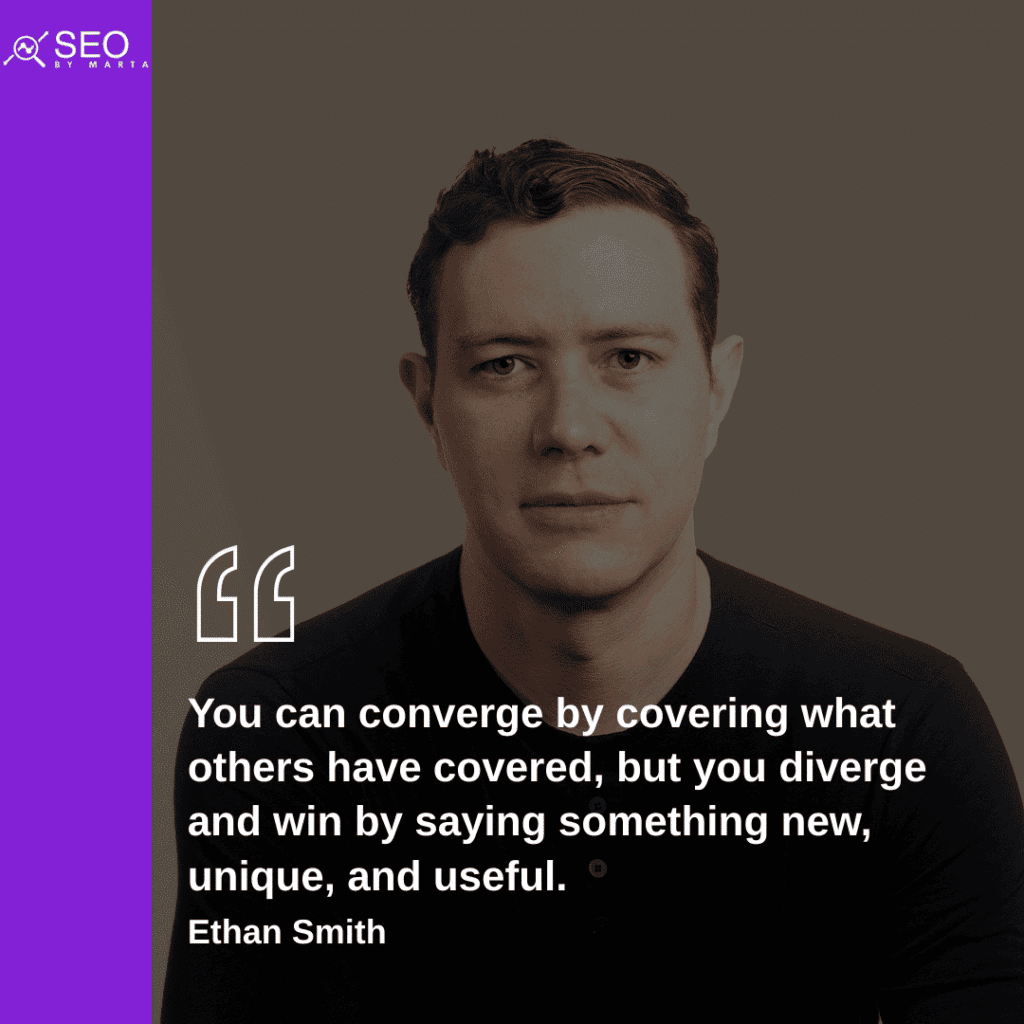
Instead, you can break out of the pack by saying something net new and useful, which is called information gain. So you can converge by covering what others have covered, but you can diverge and win by saying something new, unique, and useful.
Q: If a brand came to you tomorrow and said their traffic has dropped because AI Overviews are absorbing their clicks what’s the first thing you look at in their content, and what does a realistic fix actually look like?
A: First thing I look at is what types of queries they’re losing traffic on. If it’s informational, head-term queries: “what is X,” “how does Y work”, that traffic was always vulnerable. AI Overviews were built to answer those.
The more important diagnostic is whether they’re showing up in AI answers for the queries that matter commercially: product queries, comparison queries, “does X do Y” queries. That’s Owned AEO. If they’re not showing up there, the fix is building or restructuring help center content, creating comparison pages, covering the long-tail product question space.
Conclusion
AI Overviews reward the most extractable answer sitting inside a network of related answers. Audit every page against three questions: Does it answer a specific question completely in the first paragraph? Does it contain a citable, defensible claim? And does it sit in an architecture where neighboring pages reinforce its topical authority?
The brands winning citations right now are publishing less, but with sharper intent. They’ve moved help center content onto the main site, stopped chasing informational keywords AI now answers for free, and doubled down on commercial “does X do Y” queries where citation translates into pipeline. Google’s own documentation on AI features reinforces the same signals Ethan describes: direct answers, topical depth, and unique information gain. You can read more here on how to optimise content for generative AI.