

About Jairo Guerrero
Jairo Guerrero is an SEO strategist and software engineer who approaches search as a system — where structure, logic, and meaning come together to create visibility that lasts. As the Independent Marketing Consultant at Phanum and Co-Founder and Head of Strategy at Organic Hackers, Jairo helps global brands scale across all search channels — from Google to SearchGPT and Perplexity. His technical background allows him to bridge the gap between how websites are built and how algorithms interpret them. Known for his precision and clarity, Jairo specializes in semantic architecture, intent mapping, and entity-driven optimization. He believes SEO today isn’t about chasing keywords — it’s about teaching search engines what your business truly means.
Through Organic Hackers, he’s trained hundreds of teams worldwide to adopt a more strategic, system-based approach to SEO — one that unites content, code, and context. For Jairo, the goal isn’t just visibility. It’s comprehension.
Interview: How Intent-driven Structure, Entity Mapping, and Semantic Depth are Reshaping Search
Search has outgrown keywords. In 2025, SEO is no longer about ranking for what people type — it’s about understanding why they search. In this new landscape, Semantic SEO has emerged as the foundation of modern strategy. It’s the discipline of organizing information the way Google understands it — through intent, entities, and context.
Jairo Guerrero has been leading this movement from the front lines. Blending his background in engineering and search, he helps brands build semantic ecosystems that align perfectly with both human intent and algorithmic interpretation.
In this exclusive interview, Jairo shares how he builds topic clusters with purpose, why entity mapping is the future of optimization, and how semantic design creates long-term visibility that transcends algorithms.
Q: Jairo, thank you for joining me. Let’s begin with the fundamentals—how do you personally define semantic SEO, and why is it such a crucial evolution for search strategy?
A: Well, semantic SEO isn’t new; it’s been a core part of the industry for a long time. Google’s algorithm has understood semantic context for years with features like ‘People Also Ask’ and autosuggest are direct proof of this. They show that Google knows what we’re looking for, often before we do.
So to me, semantic SEO is the strategy that helps you cover a much broader map within the user journey. You’re not targeting a single keyword; you’re targeting the full context and the intent a user has. Semantic SEO allows us to facilitate user discovery, helping them find exactly what they need, even if they don’t know how to phrase the question.
This is the crucial evolution. Traditional lexical search, which is purely finding specific keywords, required the user to already know what they wanted.
With semantic search, we guide them until they discover their ‘holy grail.’
With Lexical Search: A user has to search for the best waterproof hiking boots. They must already know they need “hiking boots” and that “waterproof” is a feature. The results will be pages optimized specifically for that exact phrase.
With Semantic Search: The user starts higher in the journey, searching for what to wear for a muddy walk. They don’t know the solution yet. A semantic strategy understands the context (mud, walking, outdoors) and guides them. It answers related questions like ‘How to keep feet dry while hiking?’ or ‘Are sneakers okay for hiking?’ and ultimately leads them to the solution: ‘waterproof hiking boots’. We’ve guided them from a problem to a product.
Q: When you start working on a new project, what’s your first step — mapping user intent, identifying entities, or validating keyword data?
A: My first step is always to understand the buyer persona. I need to know inside out who we are trying to help. I gather information from sales, customer service, etc.
I build a full profile or profiles of the most important people. Then I match those profiles with the business goals. Our potential customers might have 100 different problems but we can only help them with 10. And even then, the business always solves one problem for our customers.
As there are many possibilities in terms of content but limited business resources then we have to match:
- Audience pain points
- Target market size
- Competition level
- Business value
The target market size is when I get to do regular keyword research to collect relevant benchmarks of the search market. Again, these are benchmarks, keyword data should not be the only data point you trust to make decisions on content strategy.
Once I’ve done content research I get to create major content groups, I believe people call it clustering. This gets me an overview of all the potential topics we should be covering in our content strategy.
One important thing to mention is that I regularly work with strong brands with large websites. These brands already have a track record in their industry therefore their performance relies more on the content and technical SEO.
If you do not have authority within your industry then you should start by building that authority. Semantics also include brand names, for example furniture is closely related to Ikea. Without any brand authority then the website content strategy will not perform well.
Q: Many still think Semantic SEO just means adding synonyms or LSI terms. What’s the biggest misconception you see around this topic?
A: I’ve seen many people talking about Semantic SEO as if it is something new because of AI search and LLMs. Yet the most ‘semantic’ Google features have been live for a while. Google Autosuggest launched in 2008 and People Also Asked in 2015. Both features go beyond keywords and solve a semantic and contextual intent for the user.
Q: Can you walk us through how intent clustering actually works in your process? How do you go from scattered topics to a structured semantic map?
A: I used to cluster intent manually just by looking at the SERPs and finding similarities between different queries. Now, AI is way easier with tools like keywordinsights.ai doing the topic clustering at scale.
I do topic research and once I have a relevant volume of search queries I run a clustering task with Keyword Insights and from there I can start working on the prioritization and plan.
Q: How do you decide which topics deserve to become pillar pages and which ones should serve as supporting content within a cluster?
A: Let me pick as example a B2B SaaS company that sells project management software specifically designed for small creative agencies.
Query to be tested: agency project management software.
I apply the 3-factor test (hypothetical):
- Search market: I look for relevant search markets with enough demand and relevant competition. The search volume for “agency project management software” is solid (e.g., 300 searches/month). The user intent is clearly commercial and high-value. This market has great demand > Pass.
- Ranking opportunity: rule is simple, if the market is not overcrowded I take it. No major website (Forbes, PCMag) Instead, it’s a mix of competing niche tools (our direct competitors), blog posts from agency-focused websites, and forum discussions. There are no super highly authoritative generalist sites. We can definitely compete and win here > Pass
- Business goals: This intent matches our business perfectly. It’s our ideal customer. Easy to add CTAs for conversion > Pass
For B2B, once a picked the main topics i group them in 6:
- 1 x How to
- 5 x Listicles
All pieces will be related with each other which adds up to the content quality score of the website. The more we produce in quality the stronger compound effect.
Example:
- Main Pillar Listicle: “The 10 Best Project Management Software for Creative Agencies”
- “How-To” Article: “How to Build a Flawless Client-Approval Workflow”
- Supporting Listicles:
- “7 Must-Have Features for Your Agency’s PM Tool” (Educates users on what’s important, framing our solution as the best fit).
- “5 Ways Your Agency is Wasting Time Without a PM System” (Highlights the problem for those who aren’t yet solution-aware).
- “10 Project Management Tips for Handling Difficult Agency Clients” (Offers pure value and builds topical authority).
- “8 Best Asana Alternatives for Small Creative Agencies” (Captures users who are actively comparing competitors).
All 5 of these supporting articles will internally link to our main “Pillar Listicle.” This creates a dense, interlinked cluster that signals our expertise.
 Q: Measuring semantic success is tricky. What key signals or metrics do you track to prove that a Semantic SEO strategy is working?
I run “rank speed” tests. Basically, I take the content I published and see how fast it appears in search results for the target query.
I had many times that the page in question was not available in the index for about 7-10 days. That tells me that the “perceived” quality of the site is low or the site has low authority in the topic, so the content once published might not be so appealing for search engines.
I see mostly that the brand strength does most of the heavy lifting when it comes to “ranking speed” but brand in itself is not the only factor. A combination of content quality and brand strength makes you rank at speed.
I had a B2B client who published hundreds of articles and pages with zero impact on traffic or leads. They had a strong brand in their niche but the content quality was low. We published a handful set of bottom-funnel articles and how-tos and we were able to rank #1 for the main business keyword within 24 hrs. We offered the highest value on all the pieces we published and that level of quality got rewarded pretty rapidly. To me that is the best way I measure the impact of Semantic SEO.
I wrote a full article about this case study on the GTM Strategist newsletter by Maja Voje, you can check it out here: How to Win the New SEO Game.
Q: Internal linking can be the bridge between meaning and authority. How do you approach internal links as part of your semantic architecture?
A: I usually work with large sites and I tend to create a semantic map with the navigation on the mobile version. Let me explain. Large websites often have those “mega menus” which contain all/most items (links) of the website.
While mega menus are helpful for users, they lower content discoverability for crawlers. Mega menus can have 1000s of links added in each page, which might exhaust crawlers. Plus, those links are always the same, so there is a risk of the crawlers following the same links every time: low content discoverability.
To fix this, what I do is to cluster the navigation. The menus become dynamic. All the core links can be still available but the sublinks are only related to the current page. For example, in an eCommerce store, if I am in the page of a washing machine, I do not need direct navigation links to the collection “Sport TVs”. The intent of those pages is totally different. All available links on the page have to be related to “washing machine”.
By clustering navigation, you optimize content discoverability, within a few links the crawlers have discovered all pages related to a specific topic. Then your website becomes a fully semantically optimized building ready to rank fast.
By navigation I do not only mean the regular menus but also the structural links between pages: sidebar links, recommended pages/products or scrollable links. Also I focus on the optimization of structural internal links on the mobile version due to Google’s mobile-first indexing. Mobile version should be the most optimized version of your site.
Q: Finally, if you could leave one core message for SEOs looking to move from keyword-based tactics to intent-driven strategy, what would it be?
A: Intent-driven strategy is a much stronger approach to any marketing strategy.
- What do people want? (content strategy)
- How do they want it? (content format)
- Why do they want it? (intent)
- Why us? (branding)
Also, looking at LLM citations and quotations, intent-driven strategy helps to develop also a “prompt-driven” strategy which goes way beyond keywords and topics and focuses on what the user really needs and wants.
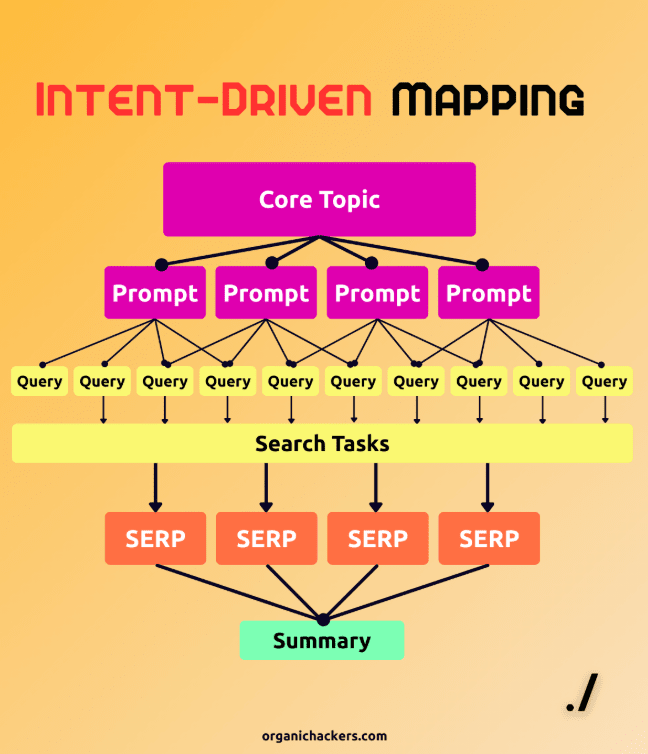
Conclusion: Stop Chasing Keywords, Start Building Meaning
Jairo Guerrero emphasises the simple truth: Google mastered semantic search in 2008. We’re the ones who’ve been slow to catch up.
It is time to forget keyword density, forget exact-match anchors, and forget gaming the algorithm. The correct SEO content approach today is the one that answers fundamental questions for real people at every stage of their journey.
What actually matters:
Start with people, not keywords. Guerrero’s three-factor test kills bad ideas before they waste your time: Does the market exist? Can you realistically compete? Does it align with what you actually sell? Most content strategies fail at least one of these.
ChatGPT and Perplexity aren’t concerned about your keyword strategy. They care whether you genuinely solved someone’s problem. Search engines don’t want to be gamed. They want to be helpful. So do your users. Maybe it’s time we listened to both.